You have an AI idea, perhaps a support assistant or a fraud detector, and both Amazon Bedrock and Amazon SageMaker AI appear capable of helping. The useful distinction is not “simple service versus advanced service.” Amazon Bedrock is primarily an application-building platform that gives developers serverless access to foundation models and managed generative AI capabilities, while Amazon SageMaker AI is an ML development platform for building, training, customizing, deploying, and operating models with greater control. [1][2][3] Choose according to what your team must control: start with Bedrock when the model can remain a managed dependency, choose SageMaker AI when the model or its infrastructure is part of what you must engineer, and combine them when those needs change across the project. [1]
The real dividing line is application control versus model control
Amazon Bedrock is a fully managed, serverless platform for building, running, and operating AI applications and agents at production scale. [1] It provides API access to foundation models from multiple providers while removing the need to manage the infrastructure on which those models run. [1][2] Its intended users include developers, technical decision-makers, and teams building AI applications or agents, and using its pre-trained models requires only basic ML expertise. [1]
SageMaker AI is a fully managed ML service for building, training, and deploying models in a production-ready hosted environment. [3] It supports generative AI, predictive ML, and classical ML, including workflows that use notebooks, pipelines, managed algorithms, custom algorithms, and distributed training. [1][3] Its advanced paths expose more of the training, deployment, framework, orchestration, and compute decisions to ML practitioners and platform teams. [1]
The important question is therefore: where does your project’s distinctive work live?
If it lives in the application—its prompts, retrieved knowledge, safeguards, workflow, or agent behavior—Bedrock is usually the closer fit. [1] If it lives in the model—its training data, optimization method, framework, deployment topology, or hardware utilization—SageMaker AI is usually the closer fit. [1] That is a decision rule, not a claim that either service has only one capability; both support model customization, but they expose different degrees of control. [1]
Example: Consider an internal assistant that answers questions from company documents. If an existing foundation model performs well and the main work is connecting documents through retrieval-augmented generation, or RAG, the project is chiefly an application-integration problem suited to Bedrock. [1] If the assistant requires a model whose behavior must be altered through specialized training and carefully controlled deployment, the center of gravity shifts toward SageMaker AI. [1]

The choice turns on whether the application or the model needs the most control
Bedrock shortens the path from a foundation model to an application
A foundation model is a broadly capable model that can be adapted to multiple tasks. Bedrock provides managed access to more than 100 such models from multiple providers. [2] Applications can invoke supported models through Bedrock APIs without managing the underlying infrastructure. [1][2]
That managed model access is only part of the service. Bedrock also provides Knowledge Bases for RAG, Guardrails for safeguards, Flows for end-to-end workflows, prompt management for reusable prompts, Data Automation for unstructured data, and AgentCore for building and operating agents. [1] It also supports model evaluation, prompt caching, intelligent prompt routing, model distillation, reinforcement fine-tuning, and custom model import. [1]
These capabilities make Bedrock useful when a team wants to compose an application around an existing model. [1] Prompt engineering can shape instructions, RAG can supply relevant private information at request time, and guardrails can apply safeguards without requiring the team to build a new model from scratch. [1]
Bedrock still permits customization. It supports fine-tuning, distillation, reinforcement fine-tuning, and the import of custom models while retaining a model-access experience with minimal infrastructure management. [1] The distinction is that infrastructure abstraction remains a central part of the service rather than something the team is expected to configure directly. [1]
Example: A content-moderation application can send text or images to a pre-trained model and use its output to identify material for review. [1] The application team can concentrate on request handling, safeguards, and the review workflow instead of creating and hosting a moderation model. [1]

Bedrock surrounds managed models with application-building capabilities
SageMaker AI makes the model lifecycle an engineering surface
SageMaker AI is appropriate when the team needs to build a model, substantially customize one, or control how training and inference run. [1][3] It supports managed infrastructure, distributed training, bring-your-own algorithms and frameworks, and deployment into secure, scalable hosted environments. [3]
There are several levels of control within SageMaker AI. Its serverless customization path supports techniques including supervised fine-tuning, direct preference optimization, reinforcement learning with verifiable rewards, and reinforcement learning with AI feedback. [1] A guided interface and AI agent-assisted workflow can handle activities such as technique selection, data preparation, training, evaluation, and deployment without requiring the user to manage infrastructure. [1]
For teams that need deeper control, managed training jobs, managed inference, and HyperPod expose training workflows, frameworks, compute resources, and orchestration choices. [1] HyperPod supports Kubernetes for training and inference or Slurm for training. [1] SageMaker AI endpoints also provide deployment mechanisms including A/B tests, canary deployments, blue/green deployments, and shadow testing. [1]
This breadth matters beyond generative AI. SageMaker AI also supports predictive and classical ML workflows, making it suitable for problems in which the desired output is a prediction or classification produced by a purpose-built model rather than generated language or media. [1][3]
Example: A financial institution developing fraud detection from its own transaction data and risk factors may need custom training, evaluation, and deployment control. [1] That requirement aligns with SageMaker AI because the model itself—and not merely the application around it—is a project deliverable. [1]

SageMaker AI exposes the model lifecycle from data through managed deployment
Four questions turn the comparison into a decision
The first question is whether an existing foundation model already meets the project’s core need. Bedrock is designed for building applications and agents with pre-trained models, prompt engineering, and RAG. [1] SageMaker AI becomes more relevant when the team must train a model, apply broader customization techniques, or incorporate classical and predictive ML. [1]
The second question is whether prompting and external knowledge are enough. RAG supplies relevant information to a model at request time, while customization changes model behavior through training. Bedrock provides managed RAG through Knowledge Bases and supports automated customization options. [1] SageMaker AI offers a broader progression from serverless customization to managed training jobs and infrastructure-level control. [1]
The third question is who will operate the system. Bedrock is optimized for application developers and teams that want minimal infrastructure management. [1] SageMaker AI serves both developers using guided customization and specialists who need direct control over frameworks, training jobs, dedicated endpoints, clusters, and orchestration. [1] Team expertise is therefore not a binary filter: SageMaker AI has accessible serverless paths, but its deepest controls are most useful when the team can make informed ML and infrastructure decisions. [1]
The fourth question is whether the team must directly tune trade-offs among cost, latency, and throughput. Bedrock offers a serverless API-based operating model and multiple inference service tiers. [1] SageMaker AI provides managed endpoints and infrastructure controls for teams that need to select resources and directly manage those trade-offs. [1]
Example: Suppose a team is building a customer-support assistant. Prompting plus RAG is sufficient, application developers own it, and nobody needs to select inference hardware: Bedrock fits those answers. [1] If evaluation later shows that changing prompts and retrieved context cannot produce the required behavior, SageMaker AI customization becomes a reasonable next step. [1]
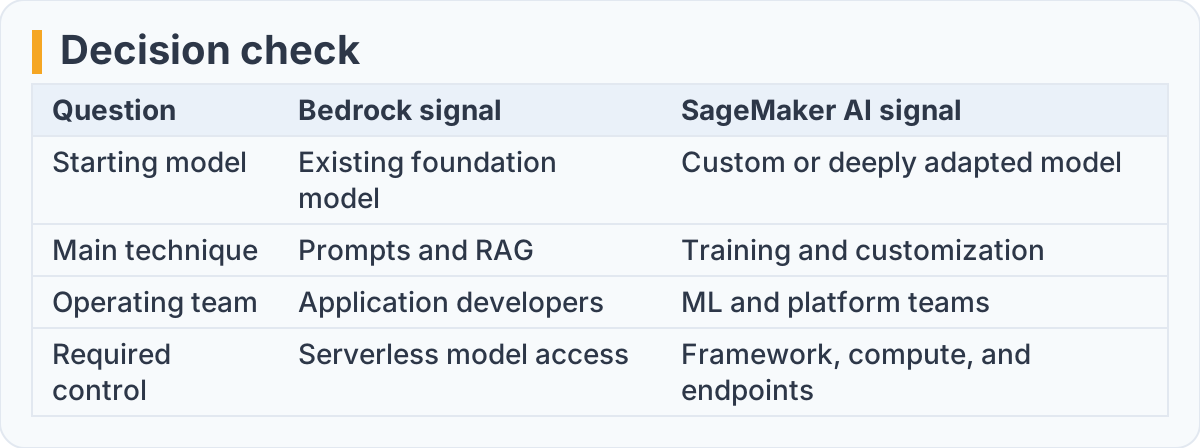
Four project questions reveal which service matches the required control
A project can move between the services instead of choosing forever
The two services are complementary, and the initial decision does not have to determine the project’s permanent architecture. [1] A common progression starts with Bedrock for prompt engineering and RAG, moves to SageMaker AI serverless customization when prompts cannot sufficiently change behavior, and advances to training jobs or HyperPod when full infrastructure control is required. [1]
Deployment can cross the boundary too. A custom model trained with SageMaker AI can run on SageMaker AI endpoints, at large scale through HyperPod, or through Bedrock after custom model import for serverless inference. [1] Conversely, a team can prototype with Bedrock inference and move to SageMaker AI endpoints or HyperPod when it needs direct management of cost, latency, and throughput. [1]
This creates a useful separation between model production and model consumption. SageMaker AI can produce or customize the model, while Bedrock can provide the serverless application-facing inference layer. [1] Alternatively, SageMaker AI can own both training and serving when infrastructure control is essential. [1]
In my judgment, teams should treat the boundary as an escalation path: adopt only the control they can name and use. If experiments demonstrate that application-level techniques meet the requirement, additional model infrastructure creates work without answering a proven need. If experiments reveal a model-behavior or serving constraint, that evidence justifies moving deeper into SageMaker AI.
Example: A document assistant can begin with Bedrock, a managed model, and RAG. [1] If domain evaluations later demonstrate that prompting and retrieval do not produce the required behavior, the team can customize the model with SageMaker AI and then choose Bedrock serverless inference or a SageMaker AI endpoint according to its operational requirements. [1]

A project can progress from managed application techniques to deeper model control
Key takeaways
- Bedrock is the stronger default when you are building a generative AI application around managed foundation models, prompts, RAG, safeguards, or agents. [1][2]
- SageMaker AI is the stronger choice when you need to build, train, deeply customize, deploy, or operate models with control over frameworks and infrastructure. [1][3]
- The decision is about required control, not simply team sophistication; both services provide managed paths, while SageMaker AI extends further into model and infrastructure engineering. [1]
- Prompting and RAG point toward Bedrock; specialized training, predictive ML, classical ML, or direct serving control point toward SageMaker AI. [1]
- The services can form one pipeline: customize in SageMaker AI, then serve through either Bedrock or SageMaker AI according to the required operating model. [1]
This comparison settles which service role matches a stated project requirement. It does not settle which particular model, customization method, deployment configuration, or architecture will meet that requirement; those choices still require evaluation against the project’s own data, quality criteria, and operational constraints.
Sources
- https://docs.aws.amazon.com/decision-guides/latest/decision-guides/bedrock-or-sagemaker.html (retrieved 2026-09-30)
- https://docs.aws.amazon.com/bedrock/latest/userguide/what-is-bedrock.html (retrieved 2026-09-30)
- https://docs.aws.amazon.com/sagemaker/latest/dg/whatis.html (retrieved 2026-09-30)
- https://docs.aws.amazon.com/aws-certification/latest/ai-practitioner-01/ai-practitioner-01.html (retrieved 2026-09-30)